

"The calm center of ourselves, that place that Watches without judging, is the destination of our sword journey"
share
  • Home
  • First Annual Swordmoot
  • Writings on the Sword
  • Video
    • The Vocabulary of the Sword
    • Basics of position and the Rule
  • Our Instructors
  • The Manual of the Piercing Cloud Method
  • Contact Us

The Sword as Distraction

5/25/2014

0 Comments

 
Picture
The Sword as Distraction

by the Arrow Mountain Tengu

Inevitably, as we inquire into the deepest aspects of swordsmanship, we encounter those who are shamefully enchanted with the sword and all that it represents.  One can smell this sort of attachment from a great distance, and can feel it in every thought and action when swords are crossed.  Swordsmen of this sort are so besotted with what they’ve learned from their venerable teachers and ancient lineages that they can barely see the opponent in front of them, and certainly have no hope of seeing themselves. They collect techniques and fancy weapons as if somehow these things matter one whit when one is faced with emergent circumstance; but, as we know, these things are in fact distractions from the true work that swordsmanship demands.

What does it mean to be enchanted with the sword?  It means that the mind is focused entirely on the sword in their hand, but not in a way that promotes analysis and learning; rather they are focused on the shiny blade, on the shiny ideas of swordsmanship, and on the shiny feelings of self-satisfaction they have dreamed up in their quest for importance and mystical meaning.  To one such as this, no amount of practice can help them pull out of the trap.  They are mired in their own desires and projections, searching for more and more, never realizing that the path of the Sword is one of less and less.  The great Masters of Old knew that only by dropping, releasing, accepting, absorbing, opening, and letting go could one begin to accord oneself properly to life and therefore the sword.  When faced with mortal threat, the Ancients didn’t puff up and fight, rather they relaxed and opened their Hand, letting the sword fall where it may, without concern for gain or loss.  By treating all circumstances as if they were life and death, they began to apply these deep principles to every aspect of their lives, to the betterment of all beings.

In these shallow days of misunderstanding and profit, the pursuit of the deepest aspects of the sword is almost entirely absent, and those that consider themselves to be inquiring deeply are splashing in a puddle in the road.  Why can’t their vision penetrate the clouds of self-delusion?  Their sword is in the way just as if they held it over their eyes.  They see the sword as a transcendent tool of self-cultivation, but refuse to look into the stark face of the sword as tool of killing.  Conversely, others see the sword as a tool of recreational violence and prestige, never seeing the light it shines on all that surrounds them, never seeing the paths it opens to the mind.  They shrink from critical analysis of what they are being taught by their teachers, never daring to test and analyze their own skills.  Their own perceptions and judgments of the sword limit their understanding.  They refuse to see the essential nature of Yin and Yang at play; without one, there is not the other.  By attempting to only understand the cultivating aspects of sword without truly understanding how it kills, one cultivates a false dream of heaven, ignoring the truth shining on our face.  By learning only the mechanics of fighting and killing without tirelessly inquiring into the true Communication that these practices illuminate, one rages alone against a hostile universe in futility.  Under these conditions, even hard practice and training can be entirely misdirected and leave one worse off than they began. 

All things Change, and all things are let go without exception.  Why, then, should we wishfully dream that swordsmanship is any different?  The sword is there in our hand, yes, but if our mind is constantly focused on the sword, it is not truly free to act.  Because of the dangerous nature of the sword, the temptation is to control circumstance with rules and forms.  As beginners, we require this structure in order build a working vocabulary for later creative expression.  As we find things that work in reality or in our imaginations, we are tempted to solidify our expressions with the sword into set techniques.  Unfortunately, real circumstance is infinite Change, not choreography. 

With rigidly codified techniques, we attempt to force our techniques onto every circumstance uncreatively, speaking over the situation rather than listening to it.  We change our perceptions of reality to fit what we understand of our techniques.  Our memory of what worked before and what we’ve been taught invents a false reality for us instead of teaching us to effectively accord ourselves to what is actually there in front of us.  If we aspire to true freedom of action, we must change our techniques to fit the circumstances that actually confront us.  We can’t truly act appropriately in a circumstance without being responsive and sensitive to what the circumstance demands. Our desperate desire to look tough and dangerous makes the idea of reacting to circumstance into some sort of weakness, but we are never doing anything but reacting to circumstance, whether real or imagined.  Even those that have excellent predictive abilities will eventually reach their limit; everyone loses at dice after enough rolls.  They are only guessing at what might happen, not truly seeing what IS happening. 

We are all floating down the river, but some chose to resist the current, while some work powerfully with it.  Swordsmanship is nothing other than flowing with the current of circumstance.  In order to do this, one must first let go of their ideas and desires and let the current take them.  Only by listening to the current and feeling it can we understand the direction and strength of its flow.  In order to listen in this way we must quiet ourselves and wait for circumstance to speak. 

If an opponent is cutting at us, we can guess and predict what they intend, and maybe we’ll be right, but if we’re wrong we are likely to be catastrophically educated.  To operate in this way is speaking rather than listening, and we are not being truly sensitive to anything except our egotistical hopes and fears.  We should rather Wait for the opponent’s intentions to become clear, so that we can deal directly with their true attack.  Only by waiting can we have the time to see what they’re actually doing.  Once we can see their true intent, we can do exactly what is necessary to resolve the situation, and paradoxically, we have more time in which to do so.  By letting our minds be distracted by the minutiae of the sword and its techniques and style, we can’t see into the truth of what’s before us and our mind ends up fluttering around like a panicked bird that flies into the temple and can’t find its way out. 

In the extremity of a contest of swords, the time for all of the fripperies is past, and only the calm mind can have true freedom of action.  Sadly, few understand this Calmness to be the true Sword with which one can cut through any illusion.  The common swordsman’s styles, their techniques and tricks, their famous teachers and their close held ‘secrets’ are merely jewelry for the ego and obstruct the mind rather than assist it.  Only by letting go can we grasp the sword.


0 Comments

Listening to the Sword

11/22/2013

1 Comment

 
Picture


A brief overview of some implications of paying attention

The Chinese have a martial concept known as Tsing Jin, which means ‘listening energy’.  This sort of listening is not done with the ears, but with the whole body and mind of the martial artist.  It just means ‘paying attention’ to what is actually there, rather than imagining, pre-conceiving, or wishfully thinking.  It also means that there are ways to learn things other than by looking and watching, which seem to provide the majority of input as we learn.  This concept is most often encountered in ‘sticking hands’ practice, in which one fights an opponent while always remaining in touching contact with them.

When we touch an opponent, if we ‘listen’ carefully to the information we receive from the point of contact with them, we begin to be able to perceive their actions in a variety of ways.  On the most basic level we can feel if that point of contact is moving and where it is moving to.  As our perceptions are trained through practice and experience, we begin to ‘hear’ actions in other parts of their body and can even start to divine their intent to a limited degree through small, subtle body movements.  It’s an easy thing to try:  simply touch someone’s arm, and have them perform various movements, such as punches with either hand, kicks, etc.  You can invariably feel these actions through the point of contact, and with practice, the amount of information passed this way increases greatly.

For most, even this amount of ‘listening’ is not something commonly taught or understood.  For the student of the sword, who practices an art that can result in death within seconds of an encounter being joined, it is critical to develop this ‘listening’ in all aspects of our training.  As swords come into contact, this ‘listening’ becomes a critical component of one’s ability to read the opponent’s movements, even when they are too fast for visual processing.  By listening we are able to know what is happening in an encounter, we can touch and guide the opponent’s sword, and we can learn their capabilities to a deep level.  Through this point of contact, we are able to feed false information to the opponent as well.  Almost everyone is ‘listening’ on subconscious levels, so we must address the opponent on every level of perception.

For example, let’s take the most basic of sword techniques: the overhead cut and the block.  When one definitively and powerfully blocks a strike, they are delivering a very clear message to the attacker:  “Your attack has failed.  Now you must take another approach or try again.”  Naturally, even the novice opponent senses this message subconsciously and will obey its logical imperative.   However, if one does not disturb the attack, meeting it and making contact but guiding the attack along its original path, the attacker does not realize the attack has not had the predicted effect until just that little bit too late, leaving them vulnerable.  It is by ‘listening’ that we are able to communicate with the opponent on many levels.

Listening has other implications as well.  Any weapon possesses inherent attributes that dictate what it will be capable of in the hands of the wielder.  By ‘listening’ to a weapon, we are able to learn what these attributes are.  For example, if we hold a sword in our hands, we can absorb a great deal of information instantly:  the weight, the number of edges, the shape of the blade, the type of guard, the pommel and point, and more.  Each of these attributes tells us something about how to use the weapon most effectively.  The weight and length will give us an idea how fast or powerful the sword is; a single or double edge immediately tells us if there are 8 different cuts or 16 available to us; the shape of the blade dictates if the blade is best used for slashing or thrusting; the type of guard lets us know how safe our sword hand(s) will be in certain positions.  For most people, a sword is a sword, with little distinction in usage, but to the student who ‘listens’, the sword can be wielded to a much greater fraction of its potential.  By ignoring the inherent attributes of a sword, we risk wielding the weapon in a manner that is less effective than it could be.   Some attributes are very obvious; few would try and wield a heavy 2 handed sword one-handed and expect to fight effectively.  Other attributes are more subtle, however; having 2 edges completely changes the techniques available to the wielder; a guard that turns up may be excellent for trapping and twisting, a guard that turns down deflects sliding attacks outwards effectively. 

The ‘listening’ approach can be extended to any weapon.  The spear is long, telling us that it works best at range.  The spearhead is not just a point but also features sharpened edges, and even a rear facing edge, telling us that it is not just a thrusting weapon, but a highly efficient cutting and slashing weapon as well.  The rear edge lets us cut as we retract the spear, giving us even more combative options.  A flexible shaft might allow for attacks around blocks that aren’t usually expected.  A heavy shaft allows for a great deal of power to be exerted from any point along the length of the spear, increasing its usefulness, even in close quarters. 

By listening to our weapon while we practice our usual techniques and forms, we can learn a great deal about what our forms and techniques really mean, and sometimes even find things that have been lost along the way.  Because of this, listening is a critical feature in any weapons training that aspires to being a living, effective style. 

Listening in this manner sounds mystical, but it’s not.  Listening to our opponent is just using more information than only our vision when we encounter them.  Listening to a weapon is just taking a logical, intelligent inventory of what a weapon can do based on its features and feel, and then just allowing the weapon to do those things with as little interference as possible from the user.  And like any technique, listening, too has its time to be grasped and its time to be let go.  The goal of developing extremely sensitive listening is to eventually be able to just ‘know’ what is going on with no mind whatsoever for analysis and clever strategizing.  We begin to be able to listen even without touching; we can hear the opponent’s intent, their spirit, and feel their movements with no physical contact.  Again, these are not mystical powers, but the result of becoming sensitive to the vast amount of data around us, and working with it as efficiently as possible rather than ignoring or resisting it.

1 Comment

Fear of the Sword

10/24/2013

0 Comments

 
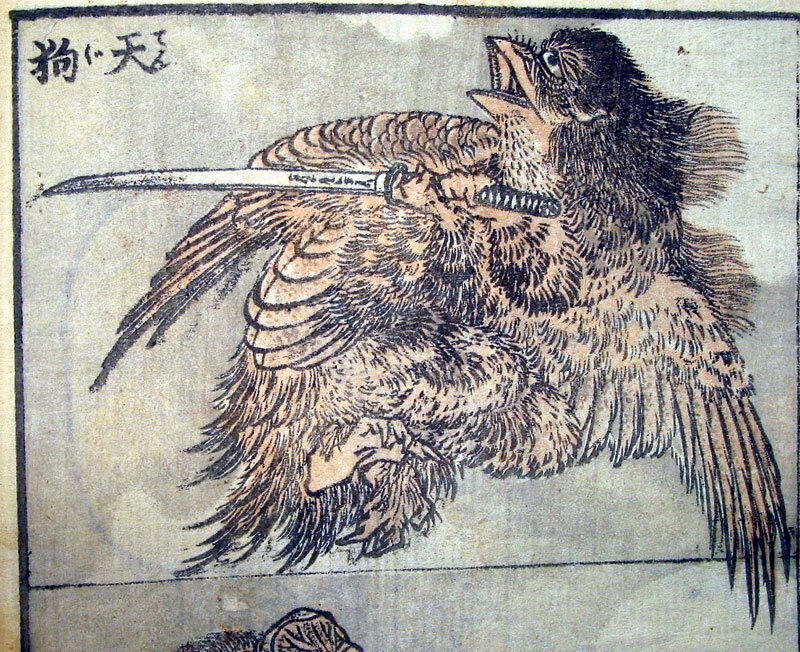
tengu by hokusai
Fear of the Sword
by the Arrow Mountain Tengu

Many people practice with swords and think they are swordsmen.  There are fancy forms and partner drills, choreographed applications, and even fights with padding and bamboo, but few of these practices really deal with fear.  Fear and its effects can be easily seen in a sword wielder’s body, jerking their eyes about, pulling up their shoulders, knocking their blade out of position, pushing them back from their opponent, and sabotaging their technique.  Fear blocks our counter-attacks, ruins our defenses, and neuters our attacks.  In order to assuage our fear, we wear more armor when we train, we make our weapons conform to narrow standards, we ‘stick to our style’, we reduce free confrontation to rigidly choreographed partner drills or to contests bound by rules carefully calculated to give advantage to our favorite forms. By giving in to our fears in such fashions, we destroy the martial content of our training and deceive ourselves about what we are capable of doing with the sword. 

Let’s step back a bit now.  There are times in training to do all of these things, but they are means, not ends.  Beginners who have not learned control must be able to safely continue training even in the face of potential accidents.  Safe swords and padding are a place to start until one’s skills start to protect them.  Beginners must use a ‘typical’ weapon until they learn the characteristics of the weapon they’re training with.  Choreography serves to provide structure within which the student can explore the techniques being studied without distraction from unpredictable actions and reactions.  All of these activities are designed to bring a student safely from the beginning of their training to the point in which they can begin to really start to learn the sword.  However, in most traditions, the training never progresses beyond this point, and all the work hits an invisible ceiling that stunts further improvement.  We can never progress past a certain point with this type of ‘safe’ training alone.  We start to ignore dangerous holes in our guard because our padding or armor has never allowed us to feel the real consequences of our mistakes.  We can become frozen in the face of attacks that aren’t part of our choreographed repertoire.  Our mind, due to the hidden limitations in our training, can harbor false expectations about what the opponent can or will do, hindering our ability to respond properly.

In order to really begin to study the sword, we must be able to face unpredictable attacks from opponents that are really trying to hit us.  We must develop the courage to stare at the unknown and wait to see what emerges. We must be able to operate at the speeds that the sword is actually capable of, and be able to deal with as much real danger as we can reasonably provide in a modern training environment.  This danger is what fuels our practice, and our practice inevitably fails without it.  Without danger, we don’t have true incentive to perform the necessary actions at the right time.  Without some danger, we aren’t provided with accurate feedback regarding the effectiveness of our techniques and concepts.  The sword is a binary system:  you are either cut or you’re not.  Proper practice that includes contact makes it harder to lie to yourself about what you’re learning.

Our training is one-sided without some risk.  Our body teaches itself a great many things in the face of danger, and by providing that danger, our training grows evenly and robustly along many parallel tracks.  There are ways to train more than just the technique we are concentrating on.  By providing some perception of danger in our training, our body can learn without intercession from the mind.  Much of our learning can become自然 ziran, or self arising (natural, spontaneous, self-so), with this content included in our training.  

On the other hand, we must also allow the mind to participate in this process, as it is not truly separate from the body.  We must also give and receive danger in how we think about our training.  We must train as if life and death hung in the balance.  When giving an attack to our training partners, we must provide them with a feeling of our intent.  Our attacks, while given at the agreed upon speeds and power levels, must have our minds behind them, as if we were going to kill.  Those who receive the techniques must operate as if they mean to kill in turn.  While we abhor violence, without this killing focus foremost in our mind our training is empty and does not give our training partners good information from which to learn.  They must feel the danger and learn to operate calmly within it.

Risk doesn’t have to mean full speed, full contact, live-blade sparring.  It can be a gentle as actually touching the opponent, rather than ‘understanding’ that you ‘could have’ touched them. It means accurate targeting when performing and receiving techniques.  It means developing our courage to stay engaged with an attacker, even when the attack is intimidating and dangerous.  It means learning to lose, and investing in our losses so that we can truly improve.  We must learn to let go of our attachments to success and failure.  We need to let go of our fear by turning to face it and confronting its true purpose in our training.


0 Comments
Forward>>

    Piercing Cloud

    occasional writings on the nature of swordsmanship by various members of the Piercing Cloud clan.

    Archives

    September 2024
    February 2019
    November 2017
    April 2017
    December 2015
    March 2015
    December 2014
    October 2014
    September 2014
    May 2014
    November 2013
    October 2013

    Categories

    All

    RSS Feed

    Up Closer To The Sky
    Up Closer To T...
    poems from a mounta...
    By Jason Deatherage
    Photo book
    Book Preview